
8 MIN READ
Fire Sprinkler Inspections: What will cause your sprinkler heads to fail?
Posted on November 20, 2026
The report comes back with a line for the fourth-floor corridor: “Sprinkler head: escutcheon missing.” You have never heard the word. It might be a $10 trim ring or a head that will not open in a fire, and the line item does not tell you which. A fire sprinkler system inspection turns up lines like this as a matter of course, and the report gives them all the same weight.
Danny Partain, who turns inspection findings into repair scopes and quotes for building owners, walked through a set of real inspection photos and answered the five questions a property manager needs for every line item:
- What is it?
- Is it cosmetic or functional?
- Why does it matter?
- How serious is it?
- What happens next?
How does a fire sprinkler head work: the basics
A wet pipe fire sprinkler system keeps water in the pipe under pressure all the way to the head. The head is held shut by a small glass bulb. When the air at the ceiling gets hot enough, the bulb breaks, the head opens, and water hits a set of fins that spread it across the room.
So a head has two jobs.
- Heat has to reach the bulb,
- Water has to get out through the fins.
Everything in this article blocks one of those two paths, and that is the test for reading any line on a report: does this stop heat getting in, or water getting out?
Three details help when reading the photos below.
- The bulb’s color is its temperature rating, so a bulb you cannot see is a rating you cannot check.
- A head belongs within a few inches of the ceiling, because that is where heat collects.
- Heads are built to point a specific way (down, up, or sideways) and have to be installed that way.
What makes a fire sprinkler head fail inspection?
A missing or recessed escutcheon lets heat past the bulb
The missing ring
“Some people are going to discount it, but typically that’s not really what you want to do.”

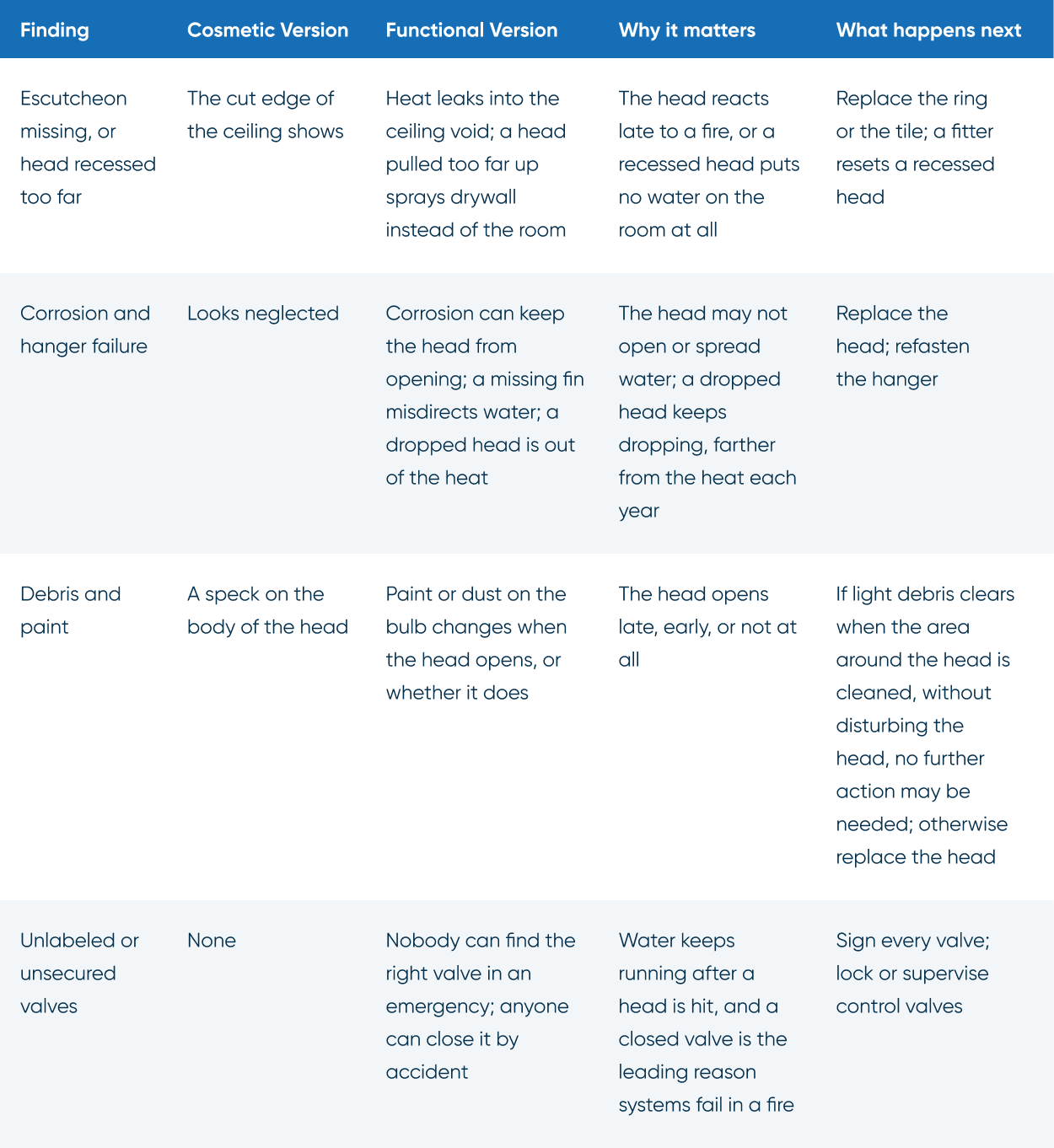
The escutcheon is the trim ring around a sprinkler head where it comes through the ceiling. In the first photo, a head in an apartment corridor, the ring was gone and the raw edge of the ceiling was showing.
- Cosmetic: you see the hole. “It’s going to look a little rough when it’s cut,” and that is what the tenant notices.
- Functional: the ring closes the gap around the head so heat stays at the bulb instead of leaking into the ceiling void. Open that gap and the head reacts slower than it should. “It’s considered part of the head,” Partain said. “Some people are going to discount it, but typically that’s not really what you want to do.” A ring that is damaged or painted over has the same problem: it is no longer doing its job.
The head pulled too far up

The second photo looked better from the floor and was the worse of the two. The outer ring was missing and the head had been pulled too far up into the ceiling.
- Cosmetic: almost nothing. From below it reads as a finished head with one ring short.
- Functional: a recessed head is built to sit flush with the ceiling. Pull it up past that point and, in Partain’s words, “when it hits the fins, it’s going to end up hitting the drywall and not actually function at all.”
The fix depends on the cause. A missing ring is replaced. A hole cut too big is a new tile, not an oversized plate to hide it.
Corrosion blocks the water
The corroded head
“Not horrible right now,” with the caveat that if nobody corrects it, it keeps dropping.

Corrosion on a head is easy to spot and easy to underrate. The head in the third photo had corrosion around the base, paint peeling off the body, and enough buildup that Partain could not tell what color the bulb was. Then he looked underneath and found the deflector missing a fin.
- Cosmetic: it looks neglected.
- Functional: corrosion at the base, where the head opens, can keep it from opening. A missing fin means water does not spread the way it should. A bulb you cannot read is a rating you cannot verify.
Fire sprinkler maintenance at this point means replacement. There is no cleaning a head back into service, and the manufacturers say so on their own data sheets.
A loose hanger moves the head away from the heat
The head hanging below the ceiling

The head in the fourth photo was hanging below a drop ceiling, which means a hanger above the tiles has probably let go or the pipe has started to sag. “Not horrible right now” was the verdict, with the caveat that if nobody corrects it, it keeps dropping, and the farther it falls the farther it is from the heat. The fix is above the ceiling: refasten the hanger and pull the pipe back up.
Paint and debris insulate the bulb, and a painted bulb has no rating
“Sprinkler heads painted” is the line on a deficiency list that a property manager is least equipped to read, because the same words cover two very different findings. A speck from a superintendent’s trim job on the body of a head is an observation. Paint on the bulb is a functional problem, and a head that has been sprayed along with the ceiling is a head that may not work. Inspectors cannot photograph every head, so the tech note and the photos that do exist are how a property manager tells the two apart.
Paint
“If we start painting that, there’s no way it’s going to go off at the right temperature.”

The painted upright in the photo set was the second kind: white, heavily coated, and “it doesn’t look like it was originally white.” The paint had covered the bulb, and the bulb is the thermostat. “If we start painting that, there’s no way it’s going to go off at the right temperature.” When paint covers the bulb, there is no telling when the head will open, or whether it will. The fix is a new head.
Debris

A spider web is the same finding in a smaller size: it catches dust, dust insulates the bulb, and the head opens faster or slower than its rating. Sprinkler heads are not cleaned, because handling one can set it off. A light web that comes away when the area around the head is cleaned is one thing; buildup that cannot be removed without disturbing the head means a new head, and grease on a kitchen head means a replacement.
What an inspection cannot tell you: whether a head should be there at all
An inspection tests what is installed. It does not ask whether something should have been installed. If a room has no sprinkler head, the inspector cannot write it up, because that is a design question. “Does it work? Is it there? Is it functional?” is the inspection, in Partain’s words. “Should it be there is an engineering survey, and that’s a whole different license.” A good inspector will tell you the room looks wrong and that the answer comes from an engineering review, which is also what a building needs after it changes use, adds storage or builds out a mezzanine.
Reading your next report: four questions for every finding
The report that landed on your desk said “escutcheon missing.” Now you know what to ask of every line item:
- Where is it?
- Is there a photo?
- Is it cosmetic or functional, and why?
- What is the fix, and what does it cost?
Ask those four questions of every finding and a deficiency list becomes something you can budget and prioritize instead of something you forward and hope about.
FSP inspects and services sprinkler systems the way this article reads them. Technicians separate the cosmetic effect from the functional one in the note, attach photos where it is feasible, and write reports built for a property manager who does not have a fire code background and should not need one. The point of an inspection is to find the least expensive path to a building that works, and a report you cannot read gets in the way of that.
Every head in your building has one job: let the heat in and let the water out. The report is how you find out whether it still can.